Don't miss our holiday offer - up to 50% OFF!

Brake Pads for Car: How to Choose the Right Type (Complete Guide)

📅 April 6, 2026 | 🕐 ~7 min read | 🔧 Car Maintenance | ✍️ traccx.store Team
Brake Pads for Car: How to Choose the Right Type (Complete Guide)
Finding the right brake pads for your car is one of the most important — and most misunderstood — maintenance decisions a driver makes. Most people grab whatever is cheapest, or whatever the parts counter recommends without understanding why. The result? Pads that squeal under light braking, wear out in 20,000 miles instead of 60,000, or chew through rotors because the wrong compound was used.
This guide clears all of that up. By the time you finish reading, you will know exactly which brake pad material suits your vehicle, your driving style, and your budget — and how to find the right fit without overpaying.
💡 Quick stat: The global brake pad market is worth over $12 billion. With that many options on offer, knowing which brake pads are right for your car matters more than ever.
Why Brake Pad Material Matters
Brake pads work by pressing against a rotating disc (your rotor) to create friction and slow the vehicle. The material the pad is made from determines how much friction it creates, how long it lasts, how much heat it can handle, and how much noise and dust it produces.
Three brake pad materials dominate the market for cars:
- Ceramic
- Semi-metallic (also called metallic)
- Organic (also called NAO — Non-Asbestos Organic)
Each is engineered for different demands. Choosing the wrong brake pads for your car is not just a waste of money — it can reduce stopping power and accelerate rotor wear. Here is how each type compares.
Ceramic vs Semi-Metallic vs Organic Brake Pads for Cars — Pros and Cons
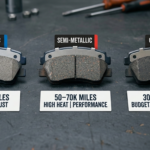
| 🔵 Ceramic | 🔴 Semi-Metallic | 🟢 Organic | |
|---|---|---|---|
| Best for | Daily commuters, sedans, SUVs | Performance driving, trucks, towing | Light daily use, older vehicles |
| Stopping power | Very good in all conditions | Excellent, especially when hot | Good in normal temps only |
| Lifespan | 70,000+ miles | 50,000–70,000 miles | 30,000–40,000 miles |
| Rotor wear | Very low | Moderate to high | Low |
| Heat tolerance | Good (not for extreme heat) | Excellent — handles high heat well | Poor — fades under heat |
| Noise & dust | Quiet, minimal light dust | More noise, darker dust | Quiet, but more dust |
| Cost | $$$ Mid to high | $$ Mid range | $ Budget-friendly |
| Cold weather | Excellent | Good | Adequate |
Ceramic Brake Pads — The Everyday Driver’s Best Friend
Ceramic brake pads are made from dense ceramic fibres and bonding agents. They run quietly, produce light-coloured dust that does not stain your wheels, and last significantly longer than organic alternatives — often 70,000 miles or more with normal use.
They perform consistently across temperature ranges, making ceramic brake pads the right car choice for most passenger vehicles, SUVs, and light trucks used for daily driving. The trade-off: they are not designed for sustained extreme heat, so track driving or heavy towing will degrade them faster than a semi-metallic compound.
Best choice for: daily commuters, city drivers, families, and anyone who wants quiet, clean, long-lasting brake pads for their car.
Semi-Metallic Brake Pads — Built for Performance and Demand
Semi-metallic pads contain 30–65% metal fibres (steel, copper, iron) mixed with friction modifiers. They excel at dissipating heat, which is why you will find them as standard fitment on trucks, performance vehicles, and cars built for towing or hauling.
The downsides are noise and rotor wear. The hard metal content is tougher on rotors than ceramic compounds — so switching to semi-metallics on a car not engineered for them may mean replacing rotors sooner.
Best choice for: truck drivers, performance car owners, and anyone who tows or hauls heavy loads regularly.
Organic Brake Pads — Simple, Quiet, and Affordable
Organic pads (NAO — Non-Asbestos Organic) are made from natural materials like glass, rubber, and Kevlar fibres bonded with resin. They are the softest of the three — gentle on rotors, quiet in operation, and the cheapest brake pads available for cars.
Their weakness is heat tolerance and longevity. Under heavy or frequent braking, organic pads fade faster than metallic alternatives and wear more quickly, averaging 30,000–40,000 miles.
Best choice for: light vehicles, older cars, and drivers doing mostly low-speed urban driving with minimal heavy braking demands.
🛒 Ready to Find Brake Pads for Your Car?
Shop ceramic, semi-metallic, and organic brake pads from verified vendors on traccx.store
Filter by vehicle make, model, and year — find the exact fit in under 2 minutes
Shop Brake Pads on traccx.store →How to Find the Right Brake Pads for Your Specific Car
Even if you have decided on a pad type, buying the wrong size wastes money and time. Follow these five steps to match brake pads to your specific car every time:
- Check your owner’s manual first. The manual specifies the recommended pad type and friction rating for your exact car. This is your baseline — never ignore it.
- Use your VIN number. Your Vehicle Identification Number (on the dashboard near the windshield or on your door frame) unlocks exact fitment data. Use a VIN decoder to cross-reference compatible brake pad part numbers for your car.
- Filter by vehicle year, make, and model. On traccx.store you can filter directly by your car’s specs to see only compatible brake pad options — no guessing required.
- Cross-reference OEM part numbers. Your existing brake pads have an OEM part number stamped on them. Use this to find direct replacements or verified aftermarket equivalents with matching specs.
- Check axle position. Front and rear brake pads for a car are not interchangeable. Front pads do roughly 70% of the braking work and wear significantly faster — always confirm you are ordering for the correct axle.
💡 Pro tip: When replacing brake pads on your car, always inspect your rotors at the same time. Worn rotors reduce the effectiveness of even brand-new pads — replacing both together extends the life of each component.
5 Signs the Brake Pads on Your Car Need Replacing
Do not wait until your brakes fail before acting. These are the five clearest warning signs your brake pads need attention now:
- High-pitched squealing when braking. Most brake pads for cars include a built-in wear indicator — a small metal tab that contacts the rotor when the friction material gets thin, deliberately creating a squeal. This is your early warning signal. Do not ignore it.
- Grinding or growling sounds. If squealing has progressed to grinding, the friction material is gone and metal is contacting metal. This causes rapid rotor damage and is a serious safety risk. Replace immediately.
- Longer stopping distances. If your car takes noticeably more distance to stop than it used to — especially in wet conditions — faded or worn brake pads are the likely cause.
- Brake pedal vibration. Pulsing or vibration through the pedal when braking usually signals uneven pad wear, warped rotors, or both.
- Visible thin pad material. If you can see the brake pad through your wheel spokes, the rule of thumb is clear: less than 3mm of friction material remaining means it is time to replace the brake pads on your car.
⚠️ Safety note: If you are experiencing grinding or your brake warning light is on, do not delay. Have your brakes inspected immediately — continued driving on compromised brake pads puts you and everyone around you at risk.
What to Budget for Brake Pads for Your Car in 2026
The cost of brake pads for a car varies significantly based on material type, vehicle application, and whether you fit them yourself or pay a mechanic. Here is a realistic breakdown:
| Pad Type | Parts Cost (per axle) | DIY Total | With Labour |
|---|---|---|---|
| Organic | $25 – $60 | $25 – $60 | $100 – $180 |
| Semi-Metallic | $40 – $100 | $40 – $100 | $130 – $220 |
| Ceramic | $60 – $150 | $60 – $150 | $150 – $300 |
| Performance / OEM | $100 – $300+ | $100 – $300+ | $200 – $500+ |
DIY installation saves 50–70% on labour costs and is a straightforward job for most cars — typically 30–60 minutes per axle with basic tools. Buying brake pads for your car through a multivendor marketplace like traccx.store lets you compare pricing across multiple verified vendors in one place, rather than paying whatever a single supplier quotes.
Which Brake Pads Are Right for Your Car? — Quick Decision Guide
| Your Situation | Recommended Brake Pad Type |
|---|---|
| Daily commuter car, mostly city or highway driving | Ceramic |
| Truck, SUV, or car used for towing or hauling | Semi-Metallic |
| Older car, budget-conscious, light driving | Organic |
| High-performance or sports car, track days | High-performance Semi-Metallic or Racing Compound |
| Electric or hybrid car | Ceramic (ideal with regenerative braking systems) |
| Current brake pads are noisy — want a quieter ride | Ceramic or Premium Organic |
| Light alloy wheels — want to keep them clean | Ceramic (produces minimal dark brake dust) |
Frequently Asked Questions About Brake Pads for Cars
Can I mix brake pad types on my car — ceramic front and semi-metallic rear, for example?
Technically possible, but not recommended for most drivers. Mixing brake pad compounds on a car creates uneven braking balance between the front and rear axles. Stick to the same pad type on both for consistent, predictable stopping. If upgrading, replace both axles at the same time.
Do I need to replace my rotors when I replace the brake pads on my car?
Not always — but always measure rotor thickness and inspect for scoring when the wheels are off. If rotors are at or below minimum thickness, or show deep grooves, replace them alongside the brake pads. New brake pads on worn rotors will underperform and wear faster than they should.
How long does it take for new brake pads to bed in on a car?
New brake pads need a bedding period of approximately 300–500 miles of normal driving to transfer an even layer of friction material onto the rotor surface. During this period, avoid hard or emergency braking where possible. After bed-in, your brake pads reach their full rated stopping performance.
Are aftermarket brake pads for cars as good as OEM?
Quality aftermarket brake pads from reputable brands — Brembo, Bosch, Akebono, EBC — match or exceed OEM performance for most everyday cars at 30–50% lower cost. The key is buying from verified vendors with clear specifications and the right fitment data for your vehicle, rather than unbranded budget pads with no documentation.
The Bottom Line on Brake Pads for Cars
Choosing the right brake pads for your car comes down to three things: your vehicle type, your driving demands, and how long you want them to last.
- For most daily drivers: ceramic brake pads offer the best combination of longevity, quietness, and rotor protection.
- For trucks, performance cars, or heavy use: semi-metallic brake pads handle heat and stress that ceramics cannot.
- For light, budget-conscious applications: organic brake pads get the job done at minimum cost.
Whatever material you choose, buying brake pads for your car from a verified vendor with clear specifications and accurate fitment data is just as important as the pad type itself. Get it wrong once and you are back to step one — with a return to process and a repair bill that did not need to happen.
🔧 Find the Right Brake Pads for Your Car
Browse brake pads by vehicle make, model & year — from verified vendors on traccx.store
Selling brake parts? Open your free store and reach buyers searching right now.
Shop Brake Pads → Open Your Free Store →